Soccer Guides / Positions and tactics
Possession play and building from the back
Why some teams try to keep the ball for long spells, how positional play and tiki-taka work, and what "building from the back" really involves.
The idea behind possession
A team that has the ball cannot concede. Possession-based teams try to control matches by keeping the ball, moving opponents around with passing, and waiting for gaps to open. Possession is a means, not an end: high possession without chances is not success.
Positional play
Positional play (often linked to the Spanish phrase "juego de posicion") divides the field into zones and gives players rules about where to stand so that the ball carrier always has several passing options. Common principles:
- Width and depth: someone holds the touchline on each side and someone stretches the defense.
- Occupying the half-spaces: the channels between the center and the wings, where defenders find it hardest to decide who should mark.
- Superiority: creating a numerical advantage (3v2), a positional advantage (a player between the lines), or a qualitative advantage (your best dribbler against their weakest defender).
- Third-man runs: player A passes to B, who lays off to C, who was the real target all along.
Tiki-taka
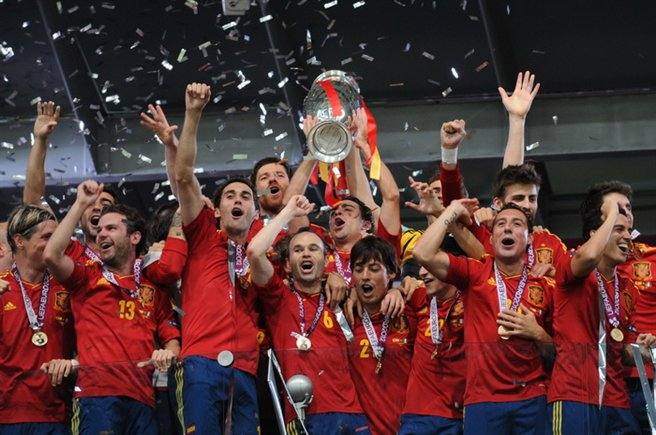
Tiki-taka describes a style of short, quick passing and constant movement, associated with Spanish club and national teams around 2008 to 2012. Spain won Euro 2008, the 2010 World Cup and Euro 2012 during that era, playing a patient passing game.
Building from the back
Building from the back means starting attacks with short passes from the goalkeeper and defenders instead of kicking long. A 2019 change to the Laws helped: on a goal kick, teammates can now receive the ball inside the penalty area.
Typical patterns:
- Center-backs split wide toward the edges of the penalty area.
- A defensive midfielder drops between or beside them, creating a three.
- Fullbacks push higher or move inside.
- The goalkeeper acts as an extra passer, creating an 11v10 against the press.
The risk is obvious: a mistake near your own goal can lead straight to a goal. Teams balance this by using a long pass when the press is too strong.
The rondo
The rondo is the classic training exercise for possession teams: a circle of players keeps the ball away from one or two defenders in the middle using one or two touches. It trains first touch, body shape, passing angles and fast decisions. See passing and first touch.
How opponents beat possession teams
- Sitting in a compact low block and denying the space between the lines.
- Pressing aggressively to force errors in build-up.
- Waiting for turnovers and launching fast counter-attacks into the space left behind attacking fullbacks.
Possession percentage is usually calculated from passes or time on the ball, and different data providers can show slightly different numbers for the same match.