Soccer Guides / Laws of the game explained
Fouls, yellow cards and red cards
What separates a careless foul from a reckless one, when the referee must show a card, and which offences mean an automatic red.
Direct and indirect free kick offences
Law 12 divides fouls into two groups. A direct free kick (or a penalty, if inside the offender's own penalty area) is given when a player does any of the following carelessly, recklessly or with excessive force against an opponent: charges, jumps at, kicks or attempts to kick, pushes, strikes or attempts to strike, tackles or challenges, or trips or attempts to trip.
A direct free kick is also given for holding an opponent, impeding with contact, biting or spitting at someone, throwing an object at the ball or a person, and handball.
An indirect free kick is given for less physical offences, such as playing in a dangerous manner (for example a high kick near an opponent's head when no contact is made), impeding an opponent without contact, and several goalkeeper offences.
Careless, reckless, excessive force
These three words decide the punishment.
| Level | Meaning | Usual sanction |
|---|---|---|
| Careless | Lack of attention or consideration, or acting without precaution | Free kick only |
| Reckless | Disregard for the danger to, or consequences for, the opponent | Yellow card |
| Excessive force | Far exceeds the necessary force and endangers the opponent's safety | Red card |
Reasons for a yellow card
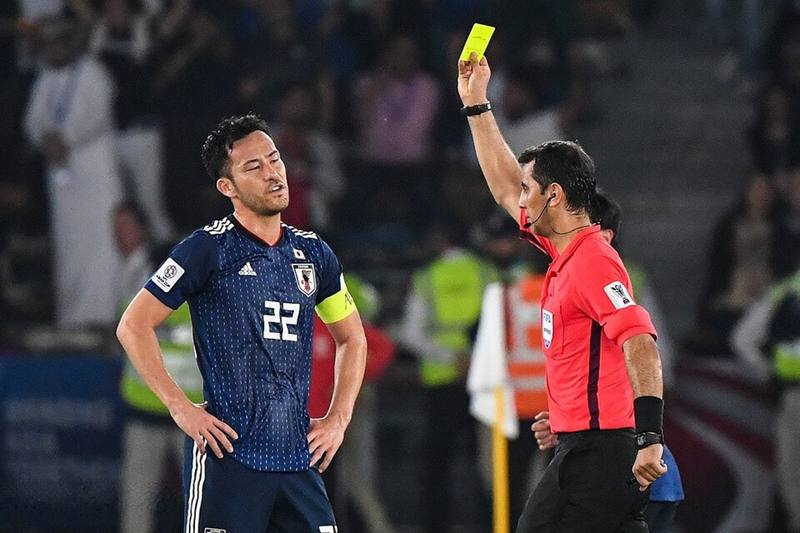
A player is cautioned (yellow card) for offences including:
- Delaying the restart of play.
- Dissent by word or action.
- Entering, re-entering or deliberately leaving the field without the referee's permission.
- Failing to respect the required distance at a corner, free kick or throw-in.
- Persistent offences (there is no set number).
- Unsporting behavior, such as diving to deceive the referee or stopping a promising attack with a foul.
Two yellow cards in the same match equal a red card.
Reasons for a red card
A player is sent off for:
- Serious foul play (a tackle that endangers safety or uses excessive force).
- Violent conduct.
- Biting or spitting at someone.
- Denying an obvious goal-scoring opportunity (DOGSO) by a handball offence, or by an offence punishable by a free kick, with some exceptions inside the penalty area.
- Using offensive, insulting or abusive language or gestures.
- Receiving a second caution in the same match.
The 2026/27 Laws give competitions the option of a sending-off for covering the mouth while making provocative comments to an opponent, and for leaving the field in protest at a referee's decision.
The DOGSO "triple punishment" rule
When a defender fouls an attacker inside the penalty area to deny an obvious goal-scoring opportunity, but was genuinely attempting to play the ball, the referee shows a yellow card instead of a red, because a penalty is already being awarded. Holding, pulling, pushing or making no attempt to play the ball still means red. When deciding DOGSO, the referee considers the distance to goal, the direction of play, the likelihood of keeping control of the ball, and the location and number of defenders and attackers. The 2026/27 Laws also say no caution is needed if the referee plays advantage and a goal is scored anyway.
Advantage
If a foul happens but stopping play would help the team that committed it, the referee can play advantage by extending both arms forward. If the advantage does not develop within a few seconds, the referee can go back and give the free kick. A card can still be shown at the next stoppage.
Cards for team officials
Coaches and other team officials can also be shown yellow and red cards for misconduct in the technical area.
At grassroots and youth level, competitions may use temporary dismissals ("sin bins") for dissent. Check your league's rules.