Soccer Guides / Laws of the game explained
The penalty kick, every rule in one place
Where the keeper must stand, when a feint is legal, what happens if someone steps in early, and the newest rule on accidental double touches.
When a penalty is awarded
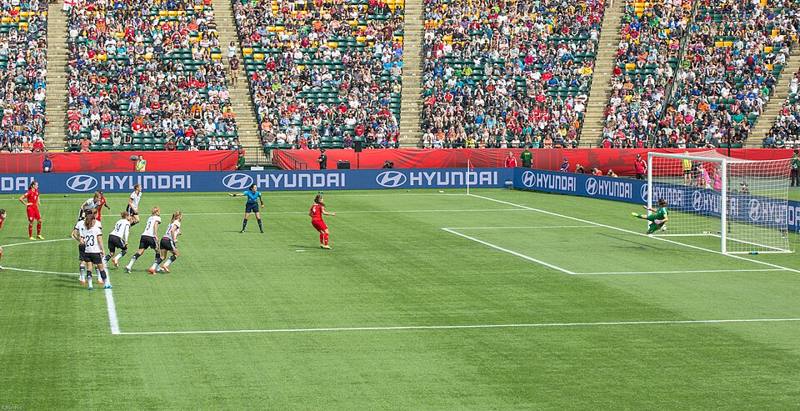
A penalty kick is given when a player commits a direct free kick offence (such as a trip, push, hold or handball) inside their own penalty area while the ball is in play. The ball does not need to be inside the area. Only the location of the offence matters, and the lines are part of the area.
Setting up the kick
- The ball is placed on the penalty mark, 11 m (12 yd) from the goal line, and must be stationary.
- The kicker must be clearly identified.
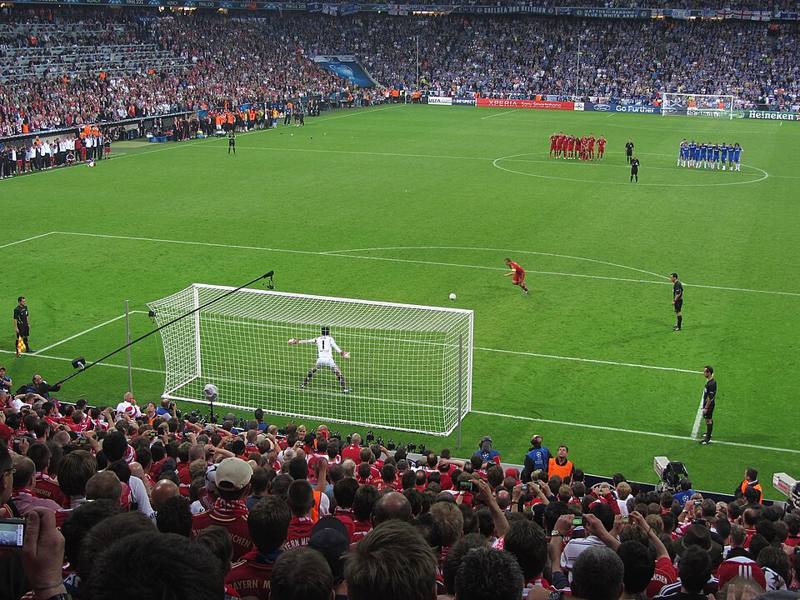
- The defending goalkeeper must stay on the goal line, facing the kicker, between the posts, without touching the posts, crossbar or net, until the ball is kicked.
- When the ball is kicked, the goalkeeper must have at least part of one foot touching, in line with, or behind the goal line.
- All other players must be on the field, outside the penalty area, behind the penalty mark, and at least 9.15 m from the mark (the arc at the top of the area marks that distance).
Taking the kick
The kicker must kick the ball forward. A back-heel is allowed as long as the ball moves forward. The ball is in play once it is kicked and clearly moves.
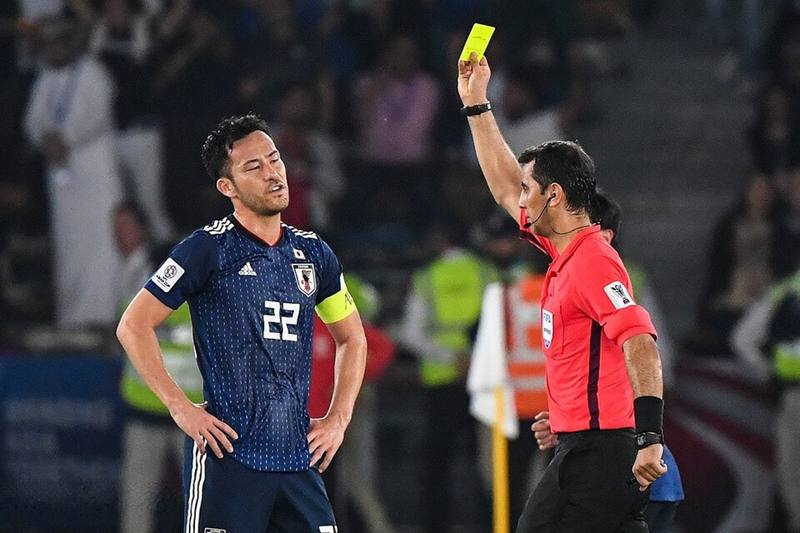
Feinting during the run-up is allowed. Feinting to kick the ball once the run-up is completed is not, and is punished with a caution and an indirect free kick to the defenders.
The kicker cannot touch the ball again until another player has touched it. A penalty can be taken as a pass to a teammate who runs into the area, but this is rarely tried because the timing is so hard.
Accidental double touch (updated rule)
Recent changes deal with the rare case where a kicker slips and touches the ball with both feet, or hits the ball with the standing foot, by accident. Under the current Laws, if the ball goes into the goal the kick is retaken, and if it does not go in, the kick is treated as missed. A deliberate second touch is still an offence.
Encroachment and other offences
Players who move into the area too early are penalized only if their encroachment has an impact, for example a defender who enters early and then clears the rebound.
| Offence | If the ball goes in | If it does not go in |
|---|---|---|
| Goalkeeper leaves the line early | Goal stands | Kick is retaken if the offence clearly affected the kicker |
| Attacker encroaches and affects play | Kick is retaken | Indirect free kick to the defenders |
| Defender encroaches and affects play | Goal stands | Kick is retaken |
| Illegal feint by the kicker | Indirect free kick to the defenders and a caution | Same |
Why penalties are so hard to save
From 11 m, a well-struck shot reaches the goal in well under a second, so keepers must commit before they can see where the ball is going. That is why goalkeepers study kickers' habits and why kickers practice a reliable routine. Read our shooting guide for technique.
The penalty kick was added to the Laws in 1891. It was proposed by William McCrum, a goalkeeper from Milford in what is now Northern Ireland.